%20Devum%20Logo.svg "(D) Devum Logo")


In the first part of this series, we explored the hidden operating costs that emerge after early low-code success, from application sprawl and governance overhead to integration debt, workaround complexity, testing effort, and long-term lock-in risk. These are the factors that quietly reshape low-code ROI once applications move from prototypes into business-critical systems.
If you have not read the first part, it is worth reviewing it to understand why many low-code programmes struggle to sustain efficiency after their initial wins. The challenges outlined there are not theoretical. They appear in real enterprise environments as adoption scales and low-code becomes part of daily operations.
In this second part, the focus shifts from what goes wrong to how to design low-code environments that avoid these costs. This edition looks at the architectural patterns, operating principles, and platform capabilities that help organisations reduce long-term operating overhead and keep low-code environments maintainable as application portfolios grow.
Rather than treating low-code as a one-time delivery accelerator, this blog focuses on how to treat it as an operating environment, one that is engineered for stability, change, and scale from the beginning.

The Real Low-code Cost Equation: Why Sustainable Platforms Become Cheaper to Operate Over Time
At this stage, the common theme becomes clear. Low-code application platforms are often evaluated as delivery engines, but they must be treated as operating environments.
The most important question is not how fast an app can be delivered. The most important question is whether the app portfolio can be operated sustainably. A strong low-code development platform reduces operating costs over time by enabling consistent modelling, reusable workflows, stable integrations, predictable access control, scalable quality practices, and architectural flexibility. A weak platform may deliver speed early and then impose increasing costs through sprawl, governance overhead, integration debt, workaround complexity, and lock-in constraints.
If you want low-code to deliver real long-term ROI, you must evaluate it through the lens of lifetime cost, not initial build cost.
How Devum™ Reduces Hidden Operating Costs: A Technical, Practical Perspective
When organisations adopt Devum™, the intent is not simply to build apps quickly. It is to build apps that can remain reliable, maintainable, and scalable as they evolve into core business systems.
Devum™ has been designed around the reality that enterprise apps are not one-time deliveries. They are living systems that need continuous improvements, integration stability, controlled governance, and operational resilience.
The features below are not just “platform modules.” They directly map to the hidden operating costs that break low-code ROI for many teams.
Limited Component Universes Result in Heavy Workarounds
One of the most expensive causes of application sprawl is inconsistent modelling. When different teams represent the same business concept differently, duplication becomes inevitable. This duplication increases maintenance cost and creates confusion in data usage across apps.
Devum™’s Data Modeller helps teams establish structured domain models that can be reused across solutions. This makes it possible to align definitions of entities and relationships across applications, preventing the “multiple versions of the truth” problem that emerges when apps are built independently.
In practical terms, this approach reduces operating costs by improving consistency and lowering duplication. It also improves collaboration because teams can build on shared definitions rather than reinventing them.

Workflow Reliability and Change Safety with Devum Workflow Builder
In enterprise software, workflows are where real operations live. Approvals, escalations, validations, handovers, and compliance steps are not static processes, they evolve continuously as teams change, policies update, and businesses scale. This is why workflow reliability becomes one of the biggest hidden operating cost drivers in low-code environments, because workflows are the part of an application that gets modified most often after go-live.
Many low-code applications become expensive to maintain when workflow logic is scattered across UI screens, duplicated across multiple apps, or buried inside hard-to-track rules. Over time, even small changes become risky because it becomes difficult to predict impact. A minor tweak to an approval condition can block an entire process, a role change can silently break access, and an escalation update can create operational delays that only show up in production.
Devum™ Workflow Builder helps reduce this operational risk by enabling teams to build workflows visually with structured steps, clear transitions, and explicit logic that is easier to understand, review, and evolve safely. This improves change predictability, reduces troubleshooting and rework, and keeps workflow-driven applications maintainable as adoption grows across teams, departments, and enterprise use cases.
Integration Sustainability through API Integration Patterns
Integration maintenance becomes expensive when teams build quick, tightly coupled connections between applications and enterprise systems. Over time, those connections inevitably break as upstream APIs evolve, authentication policies change, data models get updated, and performance expectations increase. When integrations are implemented as one-off point-to-point shortcuts, the low-code application platform slowly turns into a maintenance project, where teams spend more time fixing integrations than delivering new value.
Devum™ supports API integrations in a way that encourages reusable and maintainable integration patterns, helping teams design integrations as structured services rather than embedding fragile logic deep inside screens or workflows. This approach makes integrations easier to standardise, monitor, test, and evolve over time, especially as application portfolios grow and multiple solutions begin consuming the same external systems.
At a technical level, Devum™’s low-level and high-performance core proto-API structure supports a wide range of mainstream languages, allowing developers to generate proto clients using their preferred language compilers and implement integration logic in languages such as C#, Python, and others supported by protocol buffers. Devum™ also supports gRPC-based communication between clients and the Devum™ app runtime, enabling fast, contract-driven service communication that is easier to operate and maintain at scale. Integration reliability is not optional in enterprise environments, and investing in sustainable integration design is one of the strongest ways to protect long-term platform ROI.
Enterprise Identity Control with Single Sign-on
Identity and access control issues are some of the most underestimated sources of operational overhead. Without consistent authentication and user management, enterprises struggle with onboarding, offboarding, role enforcement, and audit compliance.
Devum™ supports Single Sign-on, allowing applications to align with existing enterprise identity systems. This reduces operational friction and ensures governance is consistent. It also reduces security risk, which is one of the most expensive categories of hidden cost in any software environment.
Data Consistency through Data Modeller
As low-code adoption grows, data handling often becomes inconsistent. Different apps may transform data differently. Reports may show conflicting numbers. Teams may struggle to identify the source of truth.
Devum™ Data Modeller supports more unified data handling patterns. This helps organisations maintain consistency across apps, reduce duplication in transformation logic, and build more reliable reporting foundations. Operationally, data consistency reduces support tickets, reduces confusion, and reduces the maintenance cost of constantly reconciling mismatched outputs.
Reduced Regression Risk with Solution Test Automation
Testing is one of the fastest-growing operational costs as app portfolios grow. Manual regression validation slows down releases and increases the risk of production issues.
Devum™ includes Solution Test Automation, helping teams reduce regression effort and improve release confidence. This supports faster delivery without sacrificing stability. The long-term benefit is fewer production issues, fewer emergency hotfixes, and a delivery process that remains sustainable as complexity grows.
Scaling Maturity through Devum™ Domain Services
Many low-code environments struggle when applications reach enterprise scale. Performance constraints appear, and teams are forced into painful redesigns or workarounds.
Devum™ Domain Services supports scaling through Devum™ Microservices Framework, enabling solutions to evolve with growing complexity and usage. This prevents the common pattern where low-code succeeds early but becomes constrained later.
Sustainable scalability is a long-term operating cost reducer because it avoids expensive rework and ensures the platform remains a viable foundation as requirements expand. 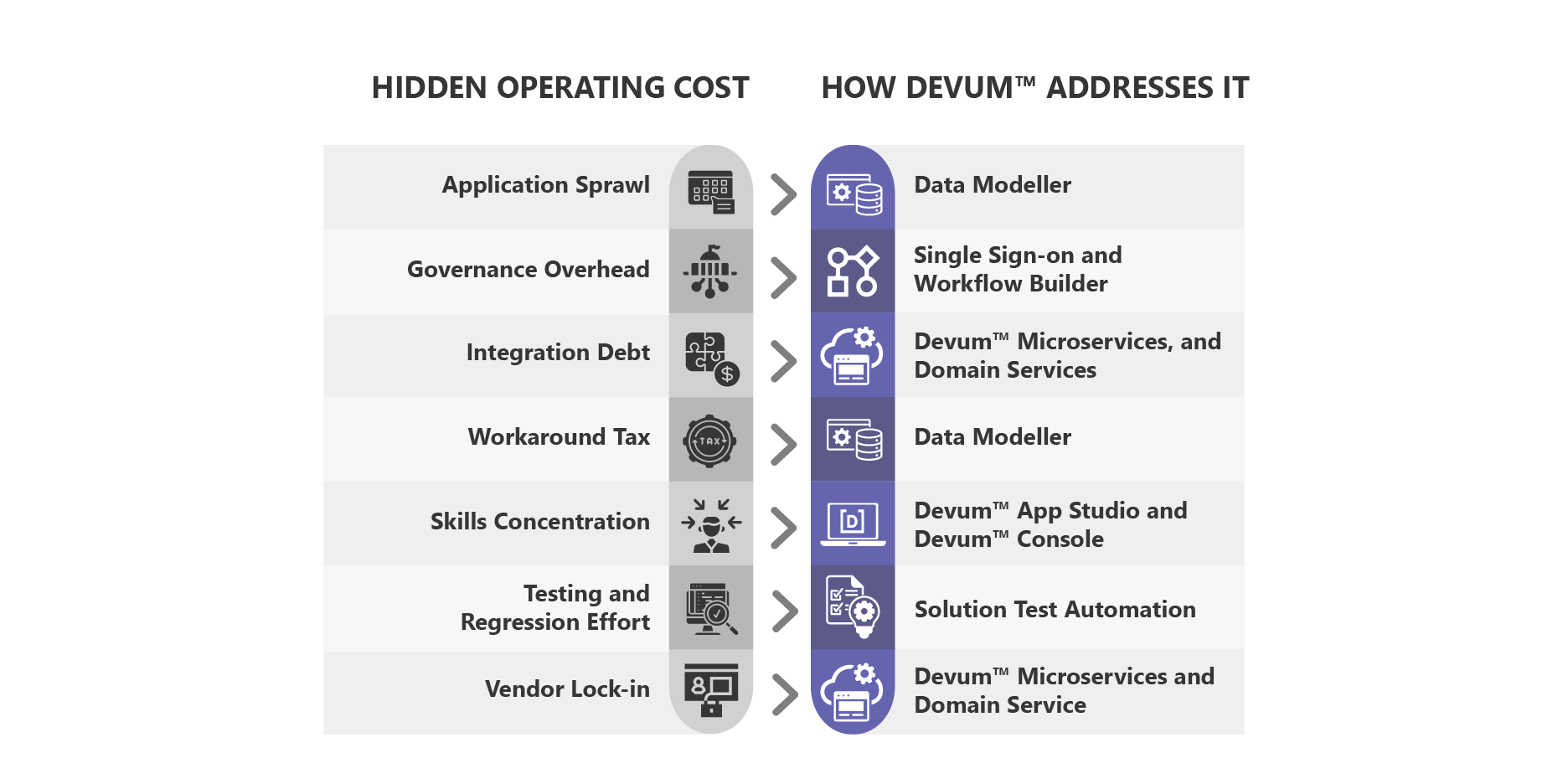
How to Evaluate Low-code Platforms the Right Way: The “Operational Fit” Checklist
Most teams evaluate low-code application platforms through demos and early prototypes. That approach is not sufficient. Demos are designed to show speed. Prototypes show what is possible in the simplest conditions. Operating cost challenges appear later in real-world conditions.
If you want to evaluate low-code realistically, you should test it like an engineering team. A proper evaluation includes a workflow that reflects real complexity. It includes integration with a real system. It includes role-based access. It includes regression testing practices. It includes a plan for how apps will be governed at scale.
When you evaluate low-code this way, the hidden operating costs become visible before you commit. That gives you the power to choose a platform that will remain sustainable long after the first release.
Conclusion: Low-code Should Make Software Cheaper to Run, Not Just Faster to Build
Low-code development is not hype. It is a real shift in how software is delivered. But the benefits of low-code application building are only sustainable when operating costs are controlled. The organisations that succeed with low-code over time are the ones that design for sustainability early, through consistent modelling, reliable workflows, scalable integration patterns, structured identity controls, unified data handling, automated quality practices, and architectural flexibility.
Hidden operating costs appear through unmanaged application sprawl, governance bottlenecks, fragile integrations, workaround complexity, skills concentration, scaling testing overhead, and vendor lock-in. These costs are not inevitable. They are preventable through disciplined adoption and the right platform foundation.
Devum™ is designed to help teams avoid these operational traps through structured modelling, workflow engineering, integration sustainability, enterprise identity controls, unified data patterns, test automation capabilities, and scalable cloud microservices.
If you want low-code to be more than an acceleration tool, you must choose a platform that supports the full lifecycle of your solutions. The best low-code platforms do not just build faster. They operate better.
If you want to experience low-code with a platform designed for sustainable operations, start by exploring Devum™ through a free trial. Build a workflow that reflects your real-world processes. Connect a real integration. Apply role-based access. Validate how your solution behaves when it grows.
The most confident low-code decisions come from real evaluation, not assumptions.
Start your journey with Devum™ today. Sign up and build your first application.
👉 Subscribe to Devum™: https://Try.Devum.com/#/security/SignUp