%20Devum%20Logo.svg "(D) Devum Logo")


Low-code development platforms have shifted from being “nice-to-have tools” to becoming serious delivery engines for digital transformation. Enterprises are adopting them to shrink delivery timelines, reduce IT bottlenecks, and keep pace with changing operational requirements. Start-ups are using them to launch products faster with smaller teams. Low-code agencies are using them to deliver more implementations without scaling headcount at the same rate.
For many teams, the first experience is almost always positive. Applications come together faster than expected. Stakeholders see outcomes early. Developers enjoy working at a higher level of abstraction. Business teams feel closer to the delivery process than they ever did with traditional development.
And then comes the part nobody advertises.
Somewhere after the first few successful deployments, low-code environments start feeling heavier. Changes begin taking longer. Maintaining multiple applications becomes complex. Integration points start breaking. Testing begins consuming more time than building. A small change request that once felt trivial now requires several people to validate, deploy, and monitor.
At that stage, the conversation shifts. Teams stop talking about how quickly they can build and start asking why it’s getting harder to operate what they have already built.
That is the moment when hidden operating costs show up.
The uncomfortable truth is that low-code application platforms rarely fail because they cannot build an application. They fail when the organisation cannot operate an expanding portfolio of low-code applications sustainably. Most adoption programmes underestimate what it takes to govern applications at scale, maintain integrations over time, keep workflows reliable, enforce security consistently, and deliver continuous improvements without breaking what is already working.
This blog is a technical, practical guide to understanding those hidden operating costs, the ones that quietly grow after your first wins and start shaping the real ROI of your low-code adoption.
In the next edition, we will cover exactly how to avoid these costs with the right operating model, evaluation approach, and platform foundation, so your low-code environment stays efficient not just during delivery, but throughout the full lifecycle of your applications.

What are Operating Costs in Low-Code, and Why Do They Matter More Than Licensing?
When most teams compare low-code application platforms, pricing is often seen as the biggest factor. People ask what the subscription cost is, what the limits are, what hosting costs will look like, and how licensing changes with additional users. These are valid questions, but they are not the full cost equation.
In enterprise environments, the largest cost is rarely what it costs to purchase a platform. The largest cost is what it costs to run solutions over time. That includes the effort required to keep applications stable and available, the work required to integrate reliably with upstream and downstream systems, the time invested in testing each release, the overhead needed to satisfy audit and compliance requirements, and the human cost of maintaining a platform when knowledge becomes concentrated in a few people.
Operating costs in low-code environments tend to grow faster than expected for one reason. Low-code dramatically lowers the barrier to building software. When building becomes easy, more software is built. When more software is built, the organisation inherits more things to maintain. The challenge is not the first application. The challenge is what happens when the organisation has twenty applications, each connected to multiple systems, serving multiple roles, running critical workflows, and needing frequent updates.
The teams that win with low-code are the ones who recognise early that low-code is not just a build tool. It becomes an operating environment for business systems. That environment must support stability, governance, and change at scale.
Hidden Operating Cost 1: Application Sprawl, or When Speed Creates an Ecosystem, You Cannot Manage
Low-code development platforms enable rapid delivery, and that speed is genuinely valuable. But without discipline, speed can create one of the most expensive problems an organisation can face: uncontrolled application sprawl.
Sprawl happens gradually. A team builds a workflow app for approvals. Another team builds a similar workflow because they were not aware the first existed. A third team builds a lighter version. Another department builds an analytics dashboard that replicates data already used elsewhere. Some applications are used daily, while others are only touched monthly. Some apps become mission critical, while others are nearly abandoned, but still deployed and still consuming attention.
Eventually, the organisation finds itself in a situation where it has a large portfolio of low-code applications without a clear understanding of which ones are core, which ones are experimental, and which ones should be retired. When the platform grows like this, operating costs rise quickly because every additional application adds another set of responsibilities. Someone has to maintain the workflows. Someone has to answer support queries. Someone has to validate integrations still work. Someone has to decide whether it is safe to deploy platform updates.
It becomes difficult to achieve clarity because sprawl makes ownership fuzzy. It also increases risk because apps may be handling sensitive data or controlling operational workflows without being tracked properly.
The technical cost of sprawl is duplication. Business logic gets repeated. Integration mapping gets repeated. User roles get recreated differently across applications. Similar screens are built in slightly different ways, and that variation becomes a long-term maintenance burden. The human cost is confusion. Stakeholders stop trusting whether the application they are using is the right one. Teams spend time discussing tools rather than improving processes.
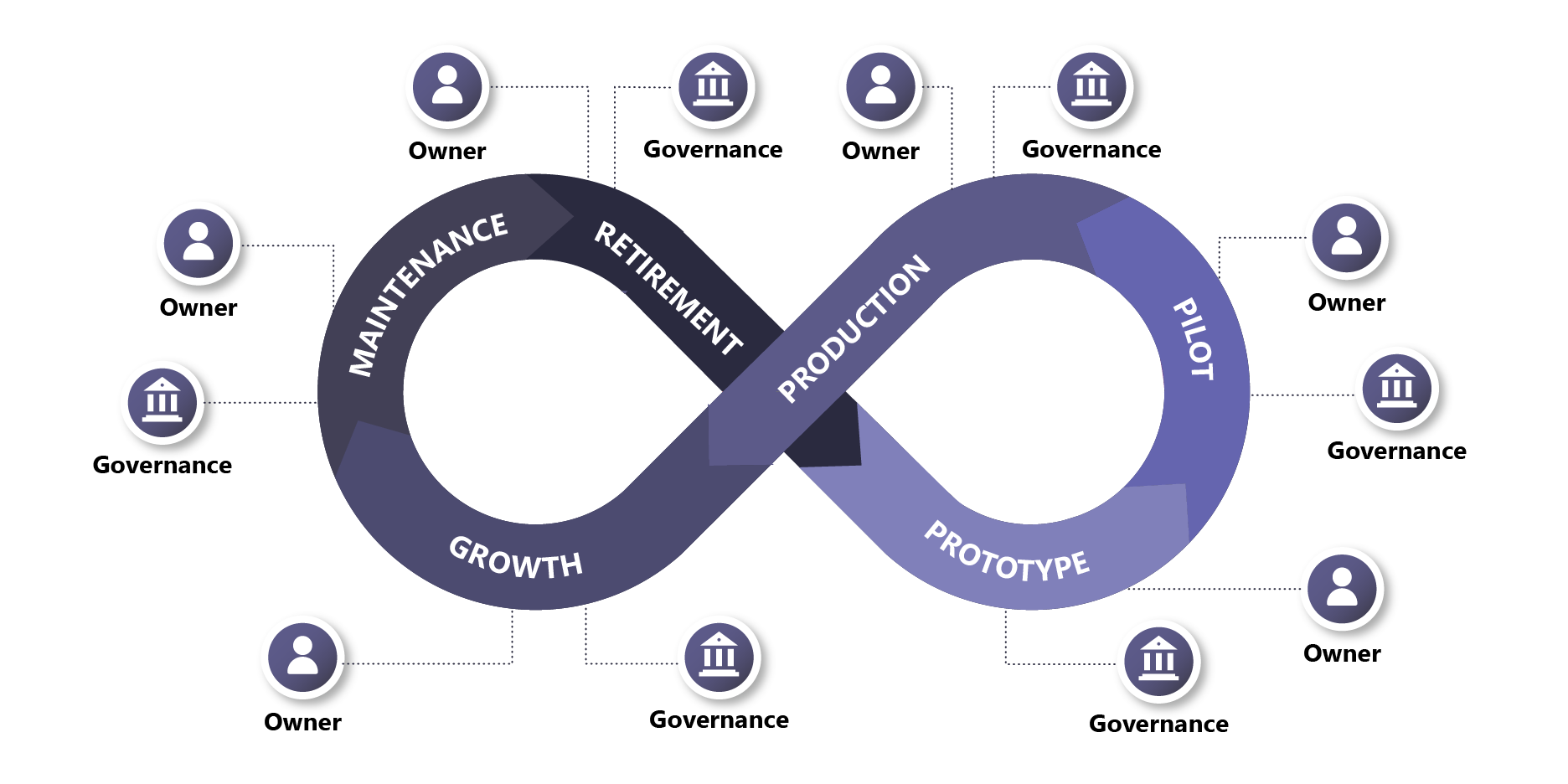
Avoiding this hidden cost requires treating low-code solutions like an enterprise portfolio, not a collection of experiments. That means defining application ownership clearly, establishing a lifecycle approach that distinguishes prototypes from production apps, enforcing reuse through domain modelling and shared services, and maintaining visibility into the entire solution landscape.
The goal should be simple: as the number of applications grows, the cost to operate them should not grow at the same rate. That is only possible when sprawl is managed intentionally.
Hidden Operating Cost 2: Governance Overhead That Turns Low-Code Into a Slow Process
Most enterprises cannot run uncontrolled software environments. Governance is not optional. Security, compliance, risk management, auditability, and operational resilience matter in real organisations. That is especially true when applications start touching operational processes, safety workflows, financial approvals, HR-related systems, or sensitive customer data.
The problem is not governance itself. The problem is how governance is implemented.
In many low-code programmes, governance begins lightly. Teams move quickly. Then, as adoption spreads, leadership becomes concerned about risk. More controls are added. Approval steps multiply. Deployment becomes a ritual. Change requests become difficult to deliver because each release needs multiple sign-offs. Eventually, low-code starts feeling similar to the very bottleneck it was meant to eliminate.
When governance becomes a barrier rather than a guardrail, operating costs rise sharply. Delivery velocity drops. Developers and business teams lose confidence. Small improvements are delayed. Stakeholders start bypassing the system because they cannot wait. Shadow IT reappears, which increases risk rather than reducing it. Teams spend more time in meetings and coordination overhead than in actual delivery.
The best low-code governance systems work like engineering controls rather than administrative gates. In other words, they allow teams to move quickly within safe boundaries, instead of slowing everything down through constant approvals. This is where structured roles, access policies, standard templates, release discipline, and automated checks matter. Governance should not be a manual bottleneck that relies on human effort for every deployment. Governance should be designed to scale.
If a low-code adoption programme succeeds, more teams will build more solutions. That means governance must scale without becoming a central bottleneck. Enterprises need controlled autonomy, where teams can innovate while still operating inside predictable rules.
That balance is what prevents governance from becoming one of the largest hidden operating costs.
Hidden Operating Cost 3: Integration Debt That Quietly Becomes Your Biggest Maintenance Burden
If you ask any experienced enterprise architect where software systems fail over time, most will tell you the same thing. They fail at integration boundaries.
Low-code environments are no different. In fact, integration risk becomes even more important because low-code accelerates app delivery, which accelerates the number of integration points an organisation inherits.
A typical enterprise application built on a low-code platform may need to connect to ERP for master data, CRM for customer context, finance systems for approvals, HR systems for identity and role mapping, data platforms for analytics, and external partner systems for transactions. It may also need to ingest real-time operational data in manufacturing or mining or interact with IoT-driven telemetry in logistics environments.
In early stages, integrations often feel easy. A connector is configured. A payload is mapped. A workflow calls an endpoint. The app is deployed. Everyone celebrates.
The hidden cost appears later when upstream systems change. An API is versioned. A field is renamed. Authentication policies evolve. Performance needs increase. Rate limits are enforced. Data formats change. A system that once responded in milliseconds starts taking seconds under load.
When integrations are built as quick point-to-point links, every system change triggers maintenance. The low-code team spends more time handling breakages than delivering enhancements. Testing effort increases because integrations affect multiple workflows and screens. Support teams receive more tickets. Users lose confidence in the reliability of the system.
This integration debt is particularly expensive because it requires ongoing attention. It cannot be ignored. It also expands over time as more apps connect to more systems.
The most sustainable approach is to treat integration logic as a reusable, service-based layer. Instead of embedding system-to-system logic deep inside a workflow or UI screen, integrations should be engineered with version awareness, consistent error handling, standard response mapping, and monitored performance.
Low-code accelerates delivery, but integration sustainability requires architectural discipline. Without that discipline, integration debt becomes one of the biggest hidden operating costs in the organisation.
Hidden Operating Cost 4: The Workaround Tax, or How Platform Constraints Generate Invisible Engineering Effort
Every platform has strengths and limitations. Low-code application platforms are no exception. The difference is that limitations often remain invisible until the complexity of real enterprise requirements begins to surface.
The first few applications are usually straightforward. They involve forms, workflows, approvals, notifications, and basic reporting. Most low-code platforms can handle this well. But enterprise systems rarely remain simple.
Over time, real requirements appear. Workflows become multi-stage and conditional. Multiple roles need different UI behaviour. Data models expand and require relationships across entities. Validation rules become complex and context-aware. Teams need reusable components across multiple apps. Security requirements become stricter. Performance expectations rise as adoption increases.
When a platform cannot support these requirements cleanly, teams begin to improvise. They build workarounds. They duplicate logic across screens. They embed complex rules where they do not belong. They create branching flows that are hard to understand. They build exceptions upon exceptions.
This is what we call the workaround tax.
Workarounds are not just messy. They create long-term operating costs because they make future changes dangerous. A small update can break something unexpected. Debugging becomes difficult because logic is scattered. New team members struggle to understand the system. Testing becomes slower because every change has unpredictable ripple effects.
In many low-code environments, the workaround tax becomes the reason why teams eventually consider rewriting solutions. That rewrite is one of the most expensive outcomes possible.
Avoiding this hidden cost requires careful evaluation of platform extensibility and architectural flexibility. A platform should support custom logic and complex workflows without forcing teams into hacks. It should allow professional developers to work confidently when complexity grows, rather than trapping them in abstractions they cannot control.
The best low-code platforms are not the ones that help you build a simple app in a demo. They are the ones that handle complexity gracefully when real-world requirements evolve.
Hidden Operating Cost 5: Skills Concentration, or Why Low-Code Still Needs Engineering Ownership
Low-code is sometimes presented as a way to avoid engineering complexity. That is a misunderstanding. Low-code reduces the amount of code you write manually, but it does not eliminate the need for engineering thinking.
In successful low-code programmes, teams still need to make decisions about architecture, integration design, workflow logic, data modelling, security, release management, and testing strategy. They need to establish standards and reusable patterns. They need to plan for change.
When these practices are missing, the knowledge required to run the platform often ends up concentrated in a few people. These may be internal champions or external consultants. They become the ones who understand how the platform works, how the workflows were designed, where integrations are embedded, and how releases should be done.
At first, this seems manageable because those people are highly productive. But as adoption grows, the dependency becomes a risk. Changes require them. Bugs require them. New requirements require them. If they become overloaded, delivery slows. If they leave, the organisation loses momentum. If they are external partners, operational costs remain high because the organisation cannot independently operate what it built.
This is a hidden cost because it is not visible in licences or development time. It appears as organisational fragility.
The remedy is shared ownership. Low-code skills must be distributed across teams, with documentation and reusable patterns that reduce dependency on individuals. Citizen developers should be empowered for safe contributions, but professional developers must retain control over core logic. The organisation must treat low-code capabilities as part of its engineering DNA, not as a shortcut that bypasses engineering.
When low-code is operated as an enterprise capability, skills concentration reduces. When low-code is operated as a convenience tool, skills concentration grows.
Hidden Operating Cost 6: Testing and Regression Effort That Expands as Your App Portfolio Grows
One of the biggest misconceptions in low-code delivery is that speed naturally reduces quality risk. In reality, speed increases change frequency, and change frequency increases the importance of testing.
Early on, low-code teams often test manually. Someone clicks through workflows, validates core screens, and deploys. For small apps, this might work. But as apps become integrated into operations, the tolerance for failure drops.
Imagine a workflow app used for approvals across multiple teams. A minor update to a role permission could block a set of users. A slight change in a workflow condition could cause approvals to stall. An integration delay could break data updates. A change in validation logic could prevent form submissions.
When such systems fail, the cost is not just technical. It is operational disruption. It is lost productivity. It is downtime. It is a loss of trust in the system.
As application portfolios grow, regression testing becomes more expensive unless it is structured early. Manual testing becomes slower and slower. Teams begin delaying releases, not because they cannot build features, but because validating changes takes too long. Low-code begins losing its speed advantage.
This is why enterprise-grade low-code application platforms must support automated quality practices. Reliable environments need predictable release pipelines and regression strategies. Testing needs to evolve from being a manual activity into being a built-in practice that scales with the number of applications.
Quality is not a one-time effort. It is an operational discipline.
Hidden Operating Cost 7: Vendor Lock-in and the Long-term Cost of Losing Flexibility
Vendor lock-in is not always obvious in early adoption. In fact, organisations often do not think about it because they are focused on delivering outcomes quickly.
But as low-code applications become central to operations, lock-in becomes a strategic constraint. The more business logic and workflows are embedded into platform-specific abstractions, the harder it becomes to migrate. If the platform stores critical logic in formats that are not portable, switching becomes expensive. If data access becomes dependent on proprietary layers, moving away becomes complex. If integrations are deeply embedded, re-platforming becomes a rewrite effort.
Lock-in creates a long-term operating cost because it reduces negotiating leverage and flexibility. It limits technology options. It makes it harder to evolve the organisation’s digital strategy. It creates a sense of being trapped.
Avoiding lock-in is not about avoiding platforms. It is about choosing platforms that provide transparency, extensibility, and clear control over how logic and integrations are structured. It is also about ensuring the organisation retains ownership of the design principles behind what it builds.
Strategic flexibility is a cost worth protecting. In enterprise technology, the ability to evolve is often more valuable than the ability to deliver quickly once.

Conclusion: Knowing the Costs Early Is What Protects Your Low-Code ROI
Low-code can absolutely accelerate delivery, but speed is only one part of the equation. Once applications move from “built” to “business-critical,” the real challenge becomes operating them reliably at scale. That is where hidden costs appear, through application sprawl, governance overhead, integration debt, workaround complexity, skills concentration, regression effort, and long-term lock-in risk.
The good news is that these costs are not inevitable. They are signals that low-code has moved beyond experimentation and into an operating environment that needs structure, discipline, and the right foundations.
In the next edition of this blog, we will break down exactly how to avoid these hidden operating costs with practical strategies, architectural patterns, and evaluation checkpoints you can apply before these challenges become expensive. Stay tuned.
Start your journey with Devum™ today. Sign up and build your first application.
👉 Subscribe to Devum™: https://Try.Devum.com/#/security/SignUp