

Speed has become the currency of modern product development. Every organisation today feels the pressure to deliver faster. Markets shift quickly, customer expectations change constantly, and competition rewards companies that can validate ideas and ship updates with relentless speed. This is why the minimum viable product, once a simple testing mechanism for startups, has evolved into a strategic instrument that enterprises rely on to shorten risk cycles and accelerate innovation.
Low-code development emerged as the solution to this bottleneck. Low-code platforms promised to accelerate this journey. They offered the idea that teams could design applications visually, reduce manual coding, experiment quickly, and deliver usable software far faster than traditional development. In certain categories, low-code development platforms delivered exactly that. However, not all low-code platforms deliver the same speed, consistency, or scalability.
As industries began using low-code for more ambitious projects, especially in sectors like mining, energy, manufacturing, logistics, and asset-intensive operations, its limitations became clear. Visual builders alone could not support real-time operational workflows. Basic data structures were insufficient for complex industrial ecosystems. Many low-code tools lacked the flexibility to handle integrations, 3D visualization, GIS mapping, or custom domain logic. The result was that MVPs built on traditional low-code platforms often remained prototypes rather than pilot-ready or scalable solutions.
This is where the truth about low-code speed becomes more nuanced. Speed is not created by drag and drop components. Speed is created by architecture. Speed is created by extensibility. Speed is created by domain relevance. And in real-world environments, speed is created by the platform’s ability to support the entire journey from MVP to go-to-market launch without forcing rewrites. This is where Devum™ stands apart. It is engineered not just to accelerate development but to simplify the most complex aspects of enterprise application design.
Devum™ allows teams to move from concept to a polished, deployable MVP in record time without sacrificing reliability, security, or scalability. Using Devum™ as a reference model, this blog outlines what true low-code speed looks like, why many platforms fall short, and what modern enterprise-grade low-code capabilities must include to genuinely reduce development timelines and accelerate go-to-market success, especially for complex digital transformation use cases.

The New Meaning of Speed in Low-Code Development
Low-code application platforms were once associated with building simple business apps. But the expectations around MVPs have changed dramatically. Organisations no longer want lightweight demos. They want usable, secure, operationally aligned products that can be deployed, tested in real environments, and scaled quickly.
In this context, the definition of “speed” must evolve beyond rapid prototyping.
- Speed Means Architectural Readiness: A fast-built UI is meaningless if the data layer, business logic, or integrations cannot support the use case.
- Speed Means Integration Without Friction: Modern MVPs depend on real-time data, third-party systems, internal ERPs, asset management platforms, IoT devices, and telemetry sources.
- Speed Means Reducing Rework Later: If an MVP must be rewritten before going live, the speed advantage was an illusion.
- Speed Means Enabling Cross-Platform Delivery: A modern application must reach users on mobile, web, and PWA simultaneously.
- Speed Means Fast GTM Execution: Releasing a working version to customers or internal users quickly is one of the most critical advantages low-code application platform should offer.
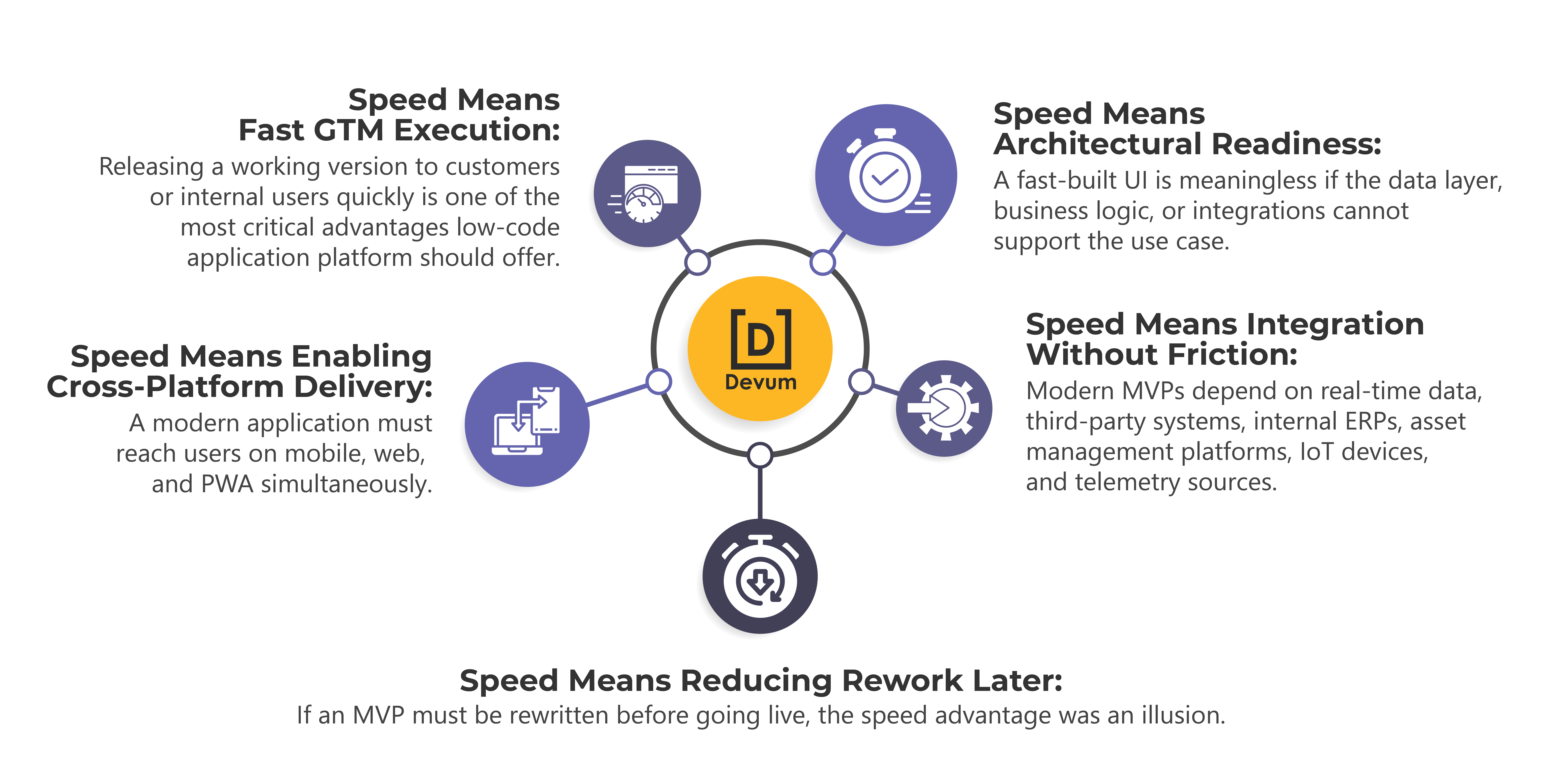
This holistic concept of speed cannot be achieved through UI builders alone. It requires enterprise-grade components, extensibility, real-time logic, advanced data structures, deployment automation, and architecture designed to evolve with the product.
Why Traditional Low-Code Platforms Struggle With Real Speed
Low-code has diversified into a spectrum ranging from simple form builders to robust enterprise development environments. Many platforms originally built for lightweight business apps do not translate well into industrial settings or environments where complexity is inherent. Below are the deeper reasons why generic low-code application platforms slow down rather than speed up MVP development when real-world complexity enters the picture.
Limited Component Universes Result in Heavy Workarounds
Traditional low-code platforms excel in simple workflows like employee requests, ticketing systems, CRM-lite applications, or internal tools. They provide a narrow set of HTML components: basic forms, charts, tables, lists, and buttons. However, enterprise and industrial applications require far more:
- Multi-layer geospatial maps
- Real-time dashboards
- 3D visualisation panels
- KPI builder
- Workflow builder
- Equipment or asset health widgets
- Process intelligence components
- Domain-specific UI patterns
Generic platforms rarely include these out of the box. Developers then rely on custom code, external frameworks, or integration hacks, which offset the time savings promised by low-code development platforms.
Basic Data Structures Cannot Handle Industrial Complexity
An MVP built on a weak data model is destined to break as soon as real users begin interacting with it. Many low-code platforms use flat data tables that work for CRUD-style apps but fail when dealing with:
- Operational hierarchies
- Multi-step manufacturing processes
- Sensor and telemetry streams
- IoT device networks
- Latency-sensitive workflows
- Time-series analysis
- Relational equipment structures
Developers must then add layers of abstraction or external storage, which complicates the build process.
No Extensibility Means MVPs Hit a Ceiling Early
One major challenge is rigidity. Many low-code development platforms allow custom logic only through restricted scripting languages or within limited sandboxes. When a platform cannot accommodate domain-specific models, custom algorithms, or new integrations, teams are forced to work around platform gaps.
This leads to slower builds, higher maintenance costs, and eventual rewrites.
Deployment Bottlenecks Slow Down GTM Velocity
An MVP is only as useful as the speed with which it reaches users. Platforms lacking automated deployment make GTM slow because deployment requires:
- Separate builds for Android and iOS
- Manual pipelines for web versions
- DevOps involvement for environment setup
- QA delays due to build inconsistencies
All of this reduces the platform’s true speed advantage.
Cloud-only Deployment Limits Enterprise Adoption
Many industries such as mining, manufacturing, and government operations require private cloud or on-prem environments for compliance. Cloud-only low-code development platforms require complex workarounds, slowing onboarding and delaying pilot launches.
These structural limitations explain why many organisations adopt low-code application platforms (LCAPs) expecting speed, only to encounter friction when attempting to build complex or industrial-grade MVPs. To truly accelerate development, a low-code development platform must deliver speed across the entire lifecycle, not just the UI layer.
What Modern Enterprise Low-Code Looks Like: The Devum™ Benchmark
Modern enterprise low-code application platforms are built from the ground up to address the shortcomings of generic tools. Devum™ illustrates what this new category of platforms must achieve. Rather than focusing on visual convenience alone, it provides a comprehensive architecture that accelerates development for simple and complex applications alike.

App Studio: Enterprise UI Development Without Compromise
Devum™ App Studio is engineered to support industrial and enterprise-grade interfaces without external dependencies. While traditional platforms limit developers to basic HTML components and generic widgets, App Studio provides powerful component libraries covering HTML, responsive forms, custom widgets, map, and full 3D suite of components. It also allows teams to design application pages that render consistently across web apps, mobile apps, and progressive web apps. Interfaces for multiple devices can be created once and deployed seamlessly to run across browsers, Android devices, iOS devices, and PWA environments, ensuring unified user experiences without parallel development.
App Studio includes Master Pages, which act as foundational layouts that define common structures, navigation systems, and styling rules across multiple screens. This ensures consistency throughout the application while significantly reducing repetitive design work. In addition, App Studio provides reusable templates that can be applied across new modules or entirely different applications. Teams can clone, adapt, and repurpose these templates to accelerate development, maintain UI standards, and reduce iteration cycles when creating multi-module or multi-application ecosystems.
Implementation Snapshot
Imagine building a digital twin for a mine’s crusher plant. Instead of sourcing a separate 3D engine, integrating it manually, and writing custom logic, Devum™ allows you to place a 3D model, bind real-time data, and visualize the operational state using dashboards with configurable charts and widgets, all within the same interface. Using Master Pages, you can define a consistent navigation structure across all digital twin views. With reusable templates and widgets, you can replicate inspection pages, asset information panels, and event logs across other applications without rebuilding them. The same interface can be deployed instantly to a browser, a mobile device used by a field supervisor, or a PWA designed to handle offline operations in remote zones.
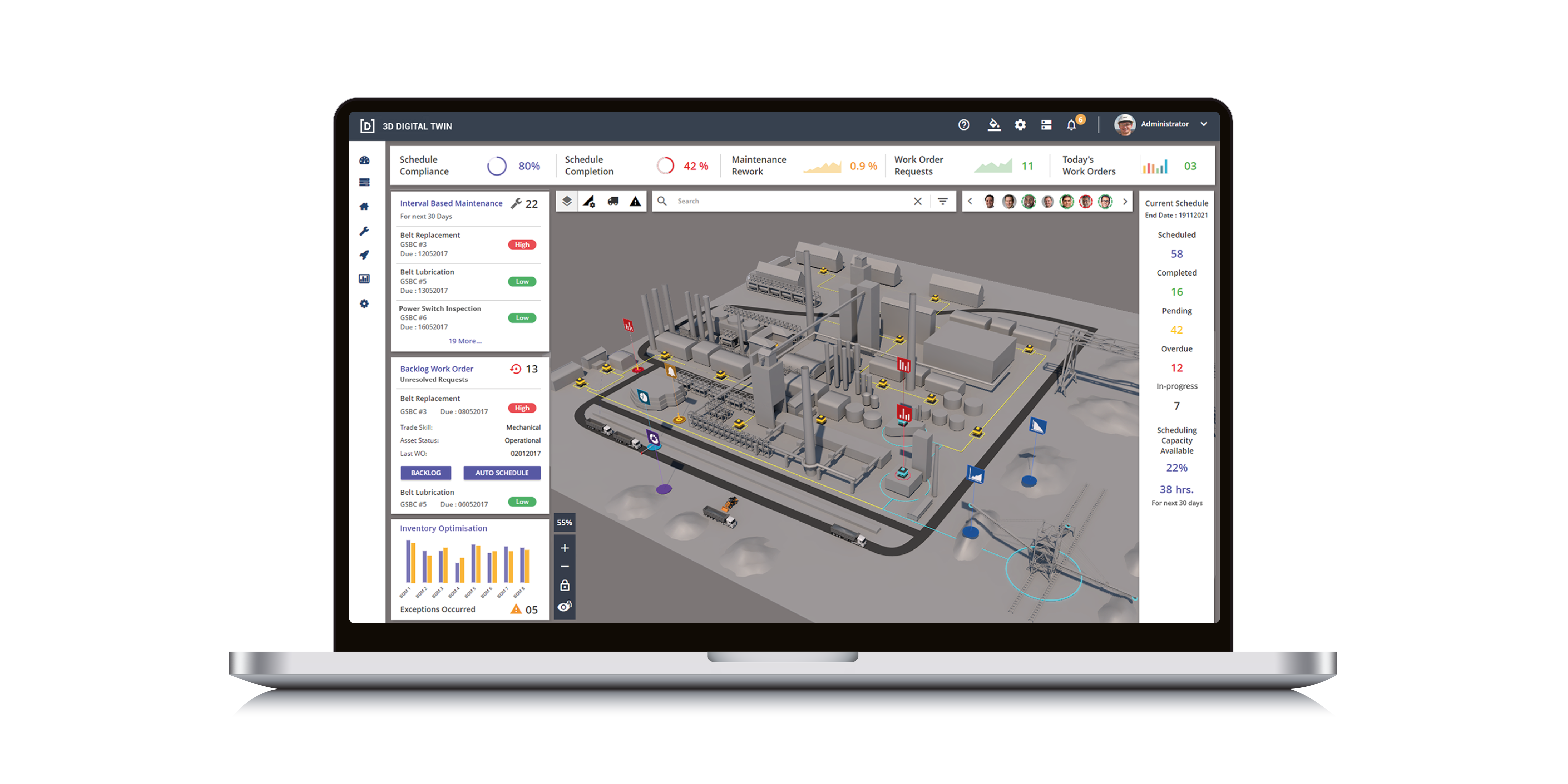
This unified, multi-platform, offline-capable design approach drastically reduces development time while ensuring that industrial users always have access to critical operational information, even in challenging environments.
Workflow Builder: Orchestrating Processes with Clarity and Control
The Workflow Builder in Devum™ enables teams to create structured, end-to-end business processes visually while maintaining the depth needed for enterprise and industrial applications. It provides a streamlined design canvas where users can define task flows, decision points, system actions and user interactions without writing code. This allows developers and domain experts to translate operational logic into working processes quickly and consistently.
A key advantage of the Workflow Builder is its ability to connect business logic directly with application data, user inputs and external services. Teams can configure workflows that initiate actions, validate information, trigger notifications or interact with third-party systems. The process engine also supports clear versioning and controlled updates, helping teams refine logic safely as requirements evolve.
The canvas is designed for clarity, making it easy to visualise how tasks progress, how decisions are made and where automations take place. This reduces development time and improves collaboration between technical staff and operational teams who must sign off on process flows.
Implementation Snapshot
Imagine building an inspection workflow for a manufacturing line. Instead of coding every validation step or building separate approval rules, the Workflow Builder lets you arrange tasks on the canvas, define the conditions that move the inspection forward and configure notifications for supervisors when issues are flagged. The flow can run the same way across a mobile inspection app, a web dashboard or a PWA used by technicians.
The simplicity of visual orchestration combined with controlled execution allows teams to design reliable processes quickly while ensuring operational consistency across environments.
KPI Builder: Turning Data Into Operational Intelligence
Devum™ KPI Builder enables teams to define, visualise and track critical business metrics without heavy coding. Unlike platforms that require manual dashboard builds or separate analytics tools, KPI Builder allows users to create KPI definitions, tie them to data sources, set thresholds and visualise outcomes using ready-to-use components. The tool supports dynamic filtering, real-time updates and reusable KPI templates so that teams can replicate proven metrics across modules or applications.
Implementation Snapshot
Imagine a manufacturing line dashboard where throughput, downtime, energy consumption and maintenance alerts need to appear side-by-side for supervisors and executives. Using KPI Builder, you define each metric once, apply thresholds for green/amber/red status, bind them to live data feeds, select a visual layout (gauge, trend line, value label tile) and deploy the same KPI set to a mobile view for field technicians. Template-based creation means the KPI definitions and visuals can then be reused in a logistics dashboard without rebuilding from scratch.
By centralising metric creation and applying reusable templates, KPI Builder reduces dashboard-development time dramatically, ensuring that metrics go live quickly and remain consistent across organisational applications.
KPIs are a core requirement for any modern application, especially those used in industrial or field operations. Devum™ KPI Builder transforms analytics creation into a guided process that allows teams to define metrics, thresholds, aggregations, and visual styles through a clean, structured interface. This ensures MVPs feel complete and operational even in early stages.
Data Modeller: Strong Foundations for Scalable MVPs
Devum™ Data Modeller enables you to architect your application’s data foundation with a domain-driven approach and visual modelling capability. Rather than relying solely on flat tables and manual schema design, you can create real-world entities, define relationships, apply business rules, create bounded contexts, and split your model across domain contexts, all within a unified visual interface.
Implementation Snapshot
Consider a mining-operations dashboard that tracks assets, inspections, production cycles and sensor logs. Using Data Modeller you define an “Asset” entity, link it with “Inspection” and “SensorLog” entities, apply relationships and business rules (for example, “SensorLog must reference Asset and timestamp”). Then you reuse this model for a manufacturing line module by splitting a “Domain Context” and replicating proven schema patterns. The unified model supports live data ingestion and subsequent KPI calculations. By modelling once and re-using your design across modules, you avoid early architectural bottlenecks and ensure that your MVP is ready to scale, without needing a rewrite when complexity grows.
Domain Services: Logical Back-end Power for Front-end Speed
Devum™ Domain Services give your application a powerful backend layer without the overhead of building backend infrastructure. Instead of stitching custom APIs, handling scheduled tasks manually, or writing boilerplate integration logic, you can design operational services directly within Devum™’s low-code environment. These services handle business rules, external system calls, scheduled logic and event-driven processes, making complex applications feel deceptively simple to build.
Implementation Snapshot
Picture a field-intelligence MVP designed for an underground mine. Equipment health logs arrive continuously, shift data updates every few minutes and inspection workflows must trigger instantly when anomalies appear. With Domain Services, you create a service that listens to new logs, evaluates thresholds, triggers alerts, assigns tasks and exposes the results over a REST API — all inside the same platform without writing a separate backend or managing microservices.
Domain Services turn your app into a living operational system. They condense backend complexity into a single development space, shorten integration cycles and ensure your MVP behaves like a production-ready solution from day one.
Devum™ DevBot: AI-Accelerated Development Using RAG
Devum™ DevBot is a built-in AI assistant powered by a Retrieval-Augmented Generation (RAG) model. Unlike generic chatbots that rely solely on large language models, DevBot pulls from Devum™’s component library, knowledge base, best-practice patterns and project templates to deliver contextual, platform-specific guidance. It helps developers and citizen build teams by generating screen templates, proposing workflow flows, writing validation rules, suggesting data schemas, and offering troubleshooting assistance.
Implementation Snapshot
Imagine a team building a mobile inspection app for a mining site and encountering a workflow branching issue. They open DevBot, describe the requirement, and instantly receive a recommended workflow diagram, a validation rule snippet, and a KPI template to plug into their UI. Because DevBot is trained on Devum™’s own architecture and design patterns, its suggestions are alignment-ready and reduce trial-and-error.
By embedding AI support directly into the development flow, Devum™ DevBot accelerates onboarding, reduces configuration mistakes and shortens the gap between idea and implementation, helping teams focus more on outcomes and less on platform learning.
Devum™ SDK: Unlock Custom Code, Fully Extend Your Platform
The SDK in Devum™ provides a professional-developer-friendly framework that enables teams to write custom logic, integrate with external systems, and package microservices in Java, Scala or any language compatible with gRPC (including Python, C#, etc.). This overcomes one of the key limitations of generic low-code development platforms by offering true extensibility and full architectural control.
Implementation Snapshot
Consider an industrial scenario where a predictive-maintenance algorithm written in Python analyses sensor streams, detects early failure indicators and triggers workflows based on the result. Using the SDK you define a DevumFunction, implement your logic, compile it into a microservice, deploy it anywhere (cloud, edge, on-prem) and bind it into your workflow or domain service without rewriting your low-code app. With support for gRPC-based protos, the service communicates efficiently and scales horizontally.
By providing this level of extensibility, the SDK ensures that your MVP is not confined by low-code limitations. You retain full developer control over mission-critical logic, integrations, and performance-sensitive services, ensuring your solution can grow from a rapid prototype into a production-grade system without peeling away from the low-code layer.
Devum™ Console: Unified DevOps and Deployment Management
Devum™ Console offers an intuitive administration interface that brings together environment provisioning, build management, user roles, and version control into a single dashboard. IT, DevOps and platform teams can oversee subscriptions, configure deployment pipelines, and manage mobile and web app releases (Android, iOS, PWA) from one place.
Implementation Snapshot
Imagine a project where you’re preparing to pilot a mobile inspection application across multiple sites. With Devum™ Console you create a staging environment, assign developer and operator roles, initiate a build for both Android and iOS with a single click, and preview the web-app version. You then promote the build to production, rollback if needed, and track version histories, all without switching to external DevOps tools.
By consolidating environments, builds and releases under a unified platform, Devum™ Console significantly accelerates go-to-market workflows and reduces deployment friction.
Deployment Models That Match Enterprise Needs
Devum™ supports deployment across public cloud, private cloud, and on-prem environments. This ensures that even highly regulated industries or geographically remote operations can deploy MVPs quickly and securely.
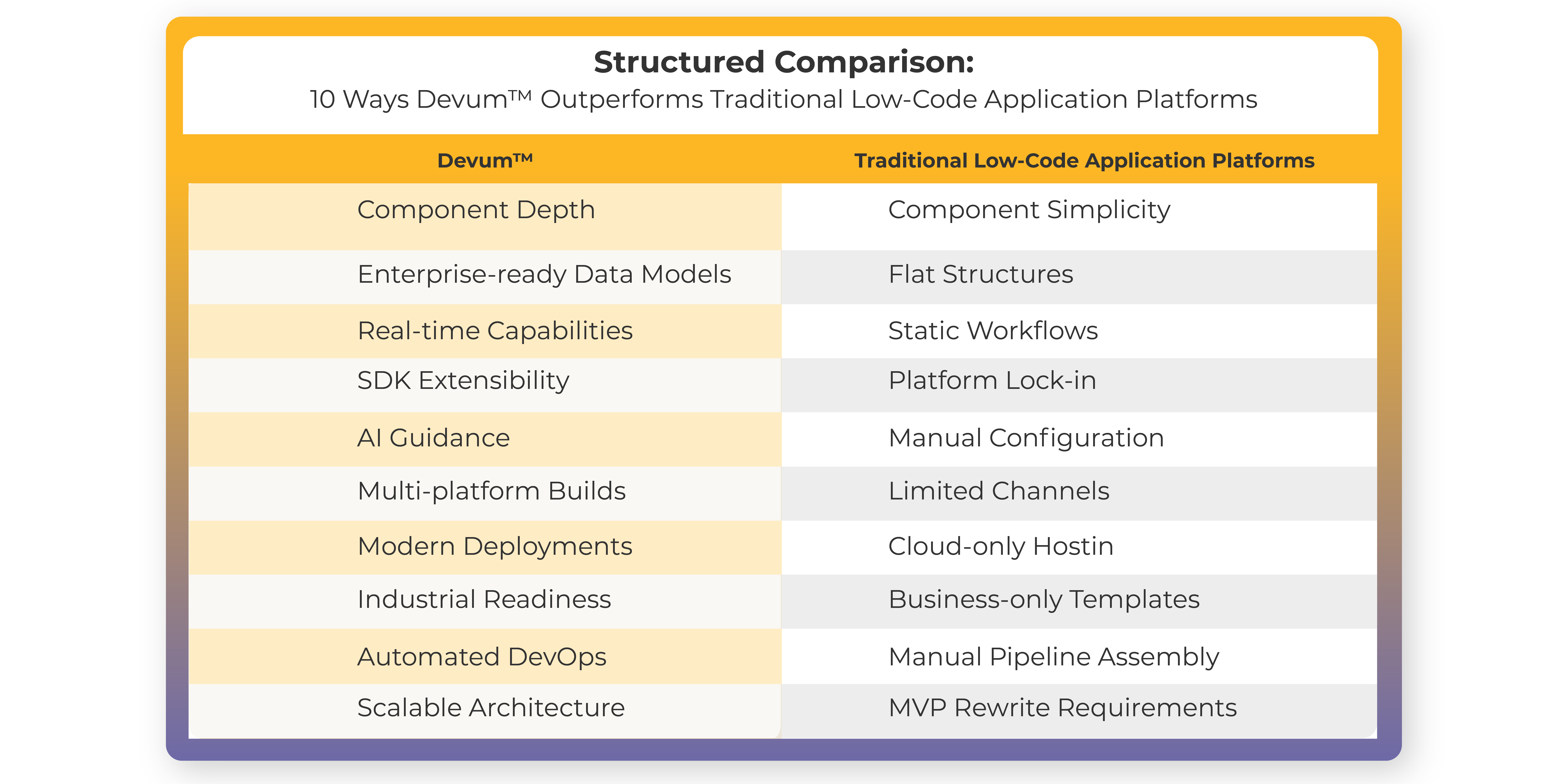
Structured Comparison: 10 Ways Devum™ Outperforms Traditional Low-Code Application Platforms
Here is a clearly structured comparison between traditional low-code platforms and next-generation platforms like Devum™. :
- Component Depth vs Component Simplicity: Traditional low-code tools offer basic UI components and widgets. Devum™ offers HTML, chart, map, 3D, form, custom widget components, process visualisations, and industrial components.
- Enterprise-ready Data Models vs Flat Structures: Devum™ Data Modeller supports both relational data designs and hierarchical or document-driven models. This gives teams the flexibility to architect robust MVPs that reflect real-world operational structures.
- Real-time Capabilities vs Static Workflows: Devum™ Domain Services support IoT, telemetry, events, alerts, and operational logic.
- SDK Extensibility vs Platform Lock-in: Devum™ SDK enables custom algorithms and integrations in Java, Python, and more.
- AI Guidance vs Manual Configuration: DevBot accelerates development through RAG-based assistance.
- Multi-platform Builds vs Limited Channels: Devum™ generates Android, iOS, Web, and PWA builds from one platform.
- Modern Deployments vs Cloud-only Hosting: Devum™ supports public cloud, private cloud, and on-prem.
- Industrial Readiness vs Business-only Templates: Devum™ goes further by offering native capabilities needed for industrial operations, such as 3D digital twin visualisation, geospatial mapping, asset-hierarchy modelling, equipment health monitoring, telemetry handling, field-mobile workflows, and real-time operational dashboards. This makes it suitable for environments like mining, manufacturing, energy and logistics where applications must reflect physical assets, processes and field conditions.
- Automated DevOps vs Manual Pipeline Assembly: Devum™ Console simplifies release cycles and testing.
- Scalable Architecture vs MVP Rewrite Requirements: Devum™ allows MVPs to scale without re-engineering.
Industrial MVP Example – Digital Twin for Remote Operations
When organisations attempt to build industrial digital twins using traditional low-code tools, they quickly encounter limitations regarding data ingestion, UI rendering, and workflow complexity. Using Devum™, a digital twin MVP can include:
- Real-time map overlays
- 3D asset representations
- IoT-driven dashboards
- Role-based workflows
- Operational KPIs
- Mobile inspection modules
- Custom Python models via SDK
All of this can be accomplished in weeks due to Devum™’s component depth, Domain Services, and deployment automation. This is the difference between low-code speed and enterprise low-code speed.
GTM Speed: The Ultimate Competitive Advantage
Speed of development matters. But speed of go-to-market is what defines commercial outcomes. Modern low-code platforms must accelerate GTM cycles by enabling:
- Rapid Prototyping: Teams can demonstrate early versions to customers and internal stakeholders.
- Fast Customer Validation: Functioning MVPs help validate assumptions with real user behaviour.
- Shorter Sales Cycles: Enterprise buyers respond faster when they can interact with prototypes that feel production-ready.
- Quicker Pilot Deployments: Deployment automation reduces time from MVP completion to field rollout.
- Iteration Speed: Feedback loops become faster when changes can be applied instantly and deployed across devices.
- Operational Experimentation: Teams can test operational workflows without displacing existing systems.
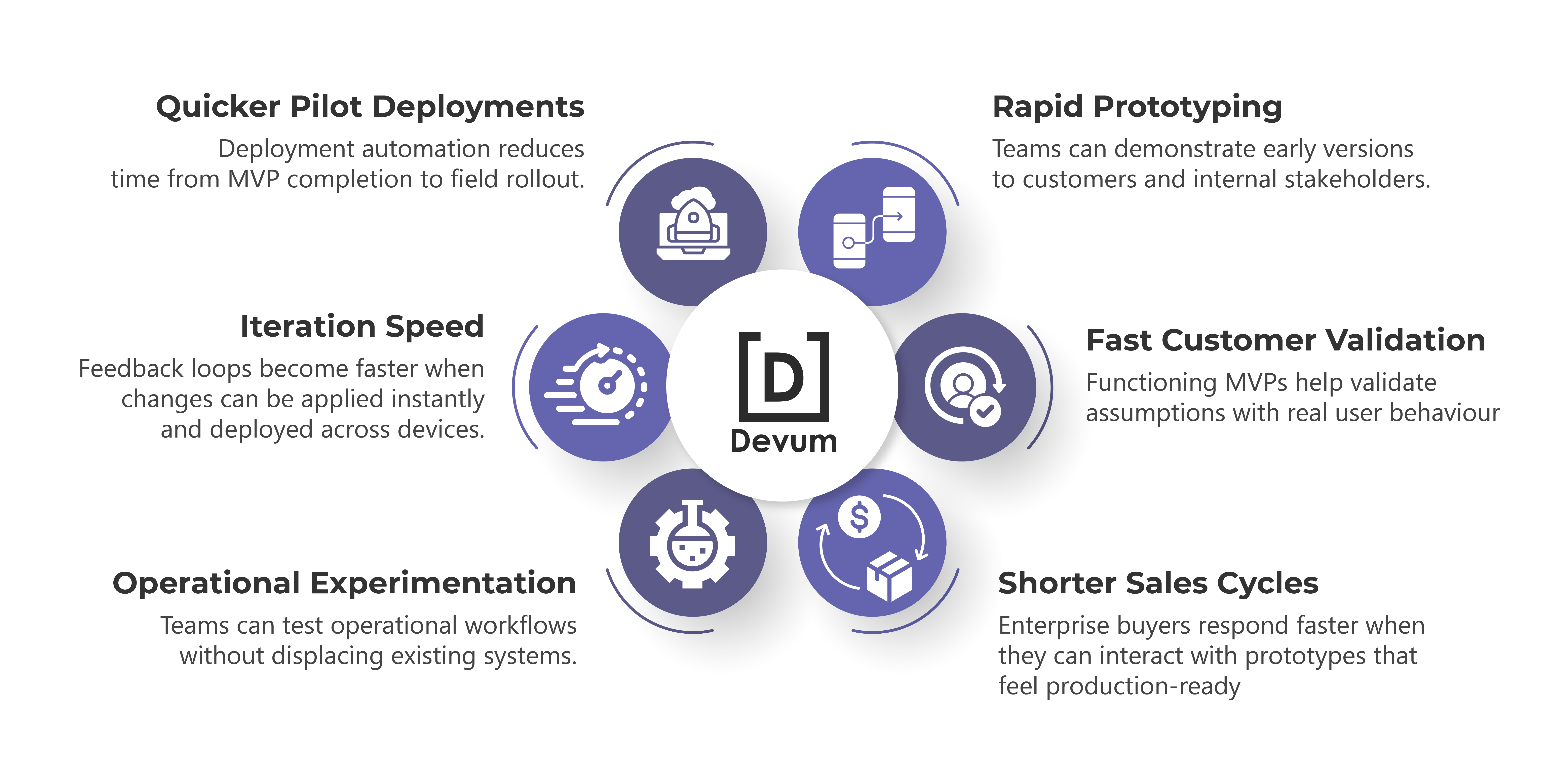
Devum™ accelerates GTM because it reduces friction across development, deployment, and iteration cycles. This is particularly valuable in industrial settings where pilot projects often determine long-term contracts and strategic partnerships.
Conclusion
The true meaning of low-code development speed has evolved. It is no longer defined by drag and drop editors or simple workflow builders. Real speed is created when architecture, intelligence, and extensibility work together to deliver production-ready MVPs quickly, reliably, and at scale.
Traditional low-code application platforms often fall short when complexity enters the picture. Modern enterprise-grade platforms like Devum™ demonstrate how low-code can support real-time operations, industrial logic, complex data structures, sophisticated UIs, extensible SDKs, and automated deployment pipelines, all of which contribute to genuine development velocity and GTM acceleration.
In a world where the first to deliver often becomes the category leader, speed is not a convenience. It is a competitive strategy. And with the right platform, organisations can bring complex ideas to life in record time.
FAQs
How fast can you build an MVP with low-code?
An enterprise-grade low-code application platform can build a functional MVP in 4 to 6 weeks.
What limits traditional low-code application platforms?
Restricted components, weak data models, limited real-time capabilities, and lack of extensibility.
Can low-code development platforms support industrial applications?
Yes, but only platforms like Devum™ with strong data models, real-time services, GIS, 3D, and extensibility can do it effectively.
What is Devum™ SDK?
It is an extensibility framework that allows custom logic, integrations, and algorithms using languages like C# and Python.
Start your journey with Devum™ today. Sign up and build your first application.
👉 Subscribe to Devum™: https://Try.Devum.com/#/security/SignUp