

Monolithic applications continue to power some of the most critical systems in banking, insurance, government, and enterprise environments. They process millions of transactions every day and support workflows that organisations cannot afford to disrupt.
In the beginning of the year, we hosted a webinar exploring why these systems begin to struggle as they scale and how those struggles surface most visibly in user experience. The discussion resonated with many teams facing the same challenges in their own environments. This blog captures and expands on those insights, translating the conversation into a practical, structured guide.
As monolithic systems grow, the user experience begins to deteriorate. Pages load slowly during peak hours. Sessions expire unexpectedly. Navigation feels unintuitive and rigid. Mobile usage becomes painful. Over time, users lose confidence in systems they depend on.
These issues are often misdiagnosed as UX or frontend problems. In reality, they are architectural constraints surfacing as user frustration. When frontend and backend logic remain tightly coupled, even minor UX improvements trigger extensive regression testing and full-system deployments. The cost of change becomes so high that teams stop improving the product altogether.
This guide explores ten recurring UX challenges that consistently emerge as monolithic systems scale. More importantly, it explains how a modular, low-code approach using platforms like Devum™ enables teams to break this cycle without risky, large-scale rewrites.

Understanding Monolithic Applications and Why They Fail at Scaling
What is a Monolithic Application?
A monolithic application is a single, tightly integrated system in which the user interface, business logic, and data layers operate as one unified unit. All features share the same codebase, deployment pipeline, runtime environment, and database.
In the early stages of development, this model offers clear advantages. Teams can move quickly. Deployments are straightforward. Communication between components happens in-process, keeping latency low. Transactions remain simple because all data lives in a shared store.
However, these benefits hold only while the system remains small and stable.
As user bases grow and business requirements evolve, the same tight coupling that once enabled speed becomes a constraint. Changes ripple through the system in unpredictable ways. Testing becomes exhaustive. Deployments become high-risk events. Scaling becomes inefficient and expensive.
When Monoliths Stop Scaling: The Real Problem
The core limitation of monolithic architecture is not its size but how changes propagate through the system.
Monoliths primarily rely on vertical scaling, adding more CPU, memory, or storage to a single server. This approach has hard limits. Eventually, no amount of hardware can compensate for lock contention, database saturation, and shared resource bottlenecks. Costs rise sharply while performance gains flatten.
Horizontal scaling is equally inefficient. Instead of scaling only the components under pressure, teams must replicate the entire application. During payroll processing or tax filing deadlines, only a small subset of features experiences extreme load. Yet monolithic architecture forces organisations to scale everything, including components that are idle.
Deployment introduces another bottleneck. Because all components are deployed together, even a small UI change requires full redeployment. A minor form validation tweak on a government portal may take weeks to reach production, not because it is complex, but because the entire system must be retested and redeployed.
Finally, monoliths act as a single failure domain. A memory leak in one module can bring down the entire system. Users experience total outages rather than isolated service degradation.
Why This Matters to Users?
Architecture feels abstract until it fails.
When users cannot renew a policy online, they do not think about vertical scaling limitations. They think the application is broken. When sessions expire mid-form submission, users do not blame deployment pipelines. They lose trust.
These UX failures are not design mistakes. They are architectural side effects of systems that cannot evolve or scale gracefully.

The 10 Key UX Challenges of Scaling Monolithic Applications
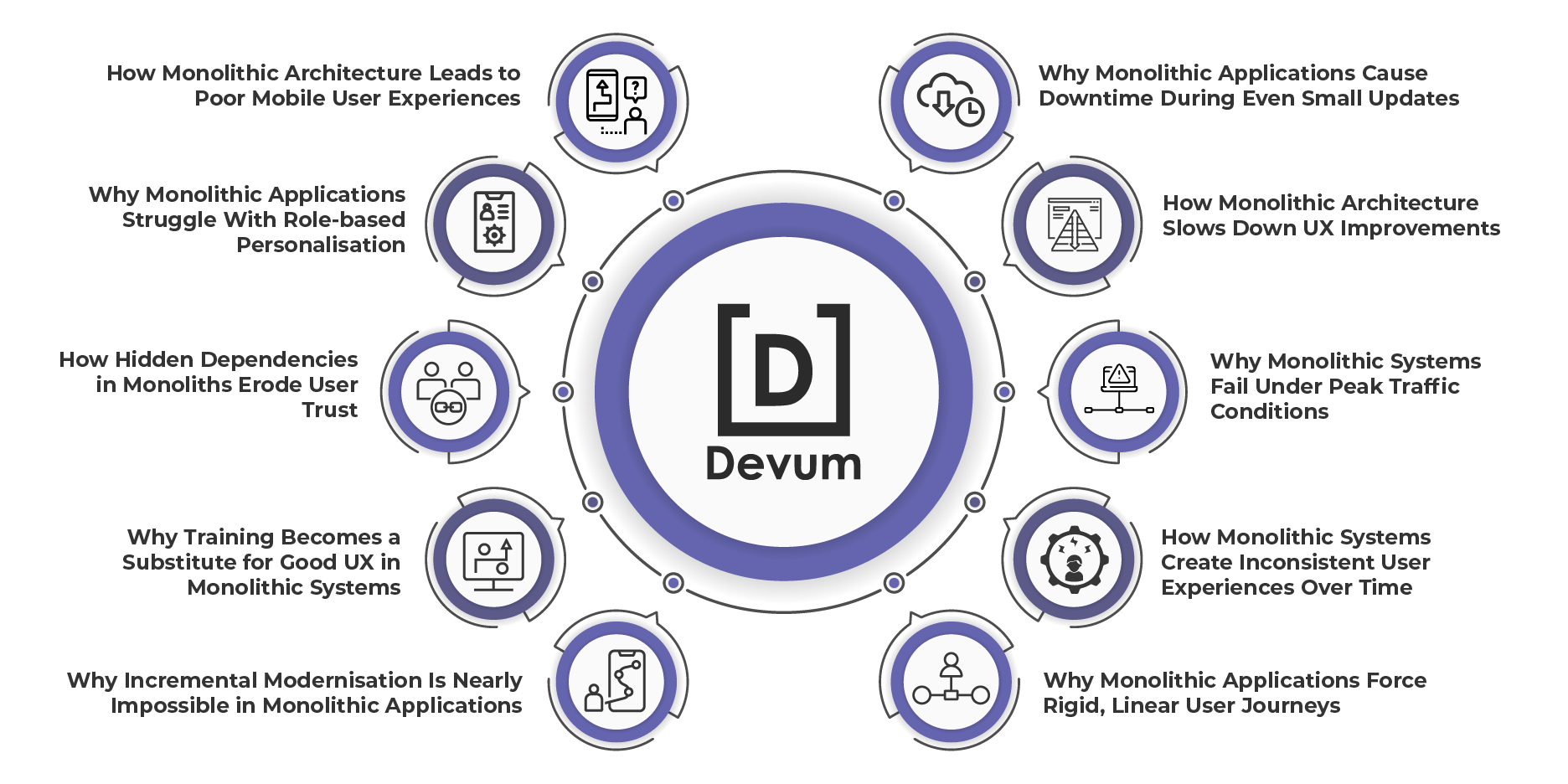
1. Why Monolithic Applications Cause Downtime During Even Small Updates?
One of the most visible UX failures in monolithic applications is downtime triggered by routine updates. Because frontend and backend logic are tightly coupled, even a minor UI fix requires redeploying the entire system. For users, this translates into forced logouts, paused transactions, and unavailable services. In large-scale environments like State Bank of India, scheduled maintenance windows mean customers cannot access balances or initiate transfers, reinforcing the perception that the platform is unreliable. This is not a deployment flaw but a structural limitation.
Devum™ addresses this by decoupling frontend updates from backend services, allowing interface changes to be deployed independently and without interrupting active users, making zero-downtime updates a default rather than an exception.
2. How Monolithic Architecture Slows Down UX Improvements?
As monolithic applications grow, UX iteration slows dramatically. Large, shared codebases mean that even small interface changes trigger extensive regression testing and cross-team coordination. Insurance platforms like LIC often take months to improve basic claim workflows, not due to design complexity but because every change risks impacting unrelated systems like payments or policy renewals. Users experience this as stagnation, where feedback is acknowledged but improvements arrive far too late. Devum™enables teams to visually model screens and workflows independently of backend logic, reducing iteration cycles from months to days and allowing users to see continuous, incremental UX improvements.
3. Why Monolithic Systems Fail Under Peak Traffic Conditions?
Monolithic applications struggle during peak usage periods because all components scale together, regardless of where demand actually exists. During high-stakes moments such as ITR filing deadlines, users face timeouts, failed submissions, and duplicate payments. The root cause is typically a shared database or backend bottleneck that cannot scale independently. Instead of isolating and scaling only high-traffic features, the entire system must be expanded, increasing cost without solving the real issue. Devum™ enables feature-level scalability, allowing high-demand journeys like payments or submissions to scale independently so peak traffic does not degrade the entire user experience.
4. How Monolithic Systems Create Inconsistent User Experiences Over Time?
UX inconsistency is a common side effect of long-lived monolithic systems. As different teams add features over years, interfaces evolve unevenly. Users might move from a modern dashboard into outdated transaction screens, as seen in SAP ECC workflows like ME21N. These inconsistencies increase cognitive load, training time, and user frustration. The reason they persist is simple. Standardising UX requires touching many tightly coupled screens, which is risky in monolithic environments. Devum™ enforces consistency through reusable UI components and templates, ensuring that every new screen aligns with a unified design system by default.
5. Why Monolithic Applications Force Rigid, Linear User Journeys?
Many monolithic systems rely on fixed, linear workflows that offer little flexibility. Insurance claim processes often require users to complete eight or more screens in a strict sequence, with no ability to revisit or adjust previous steps. If users make a mistake, they are forced to start over, leading to high abandonment rates and increased support calls. These rigid flows exist because workflow logic is hard-coded deep within monolithic applications, making conditional paths expensive to implement. Devum™ replaces this rigidity with visual, condition-based workflows that adapt dynamically based on user role, data, and context, making journeys shorter and easier to complete.
6. How Monolithic Architecture Leads to Poor Mobile User Experiences?
Most monolithic systems were designed for desktop-first usage, resulting in heavy pages and mouse-centric interactions that translate poorly to mobile devices. Government portals such as Passport Seva and the ITR portal remain difficult to use on smartphones due to slow load times, unreadable text, and non-responsive forms. Improving mobile UX in monolithic systems often requires backend changes, making even frontend-only improvements costly and slow. Devum™’s decoupled, responsive UI layer allows the same backend to support optimised desktop and mobile experiences without modification, enabling faster, touch-friendly interfaces across devices.
7. Why Monolithic Applications Struggle with Role-based Personalisation?
Personalisation is limited in many monolithic applications because presenting different interfaces for different users requires coordinated changes across multiple layers of the system. As a result, organisations default to generic screens that expose unnecessary fields and actions to everyone. In ERP systems, this means managers, operators, and administrators all see the same cluttered interface, reducing productivity and increasing errors. Devum™ simplifies role-based UI configuration by allowing visibility and access rules to be defined visually at the frontend level, ensuring users see only what is relevant to their role without backend complexity.
8. How Hidden Dependencies in Monoliths Erode User Trust?
In large monolithic codebases, hidden dependencies make changes inherently risky. A small update intended for one feature can unexpectedly affect batch jobs, calculations, or session handling elsewhere in the system. Users experience these failures as sudden bugs, incorrect data, or interrupted sessions after updates. Over time, confidence in the system declines, and users avoid certain features during deployment periods. Devum™ reduces this risk by making dependencies explicit through visual modeling and modular design, allowing changes to be tested and deployed in isolation with clearly defined impact boundaries.
9. Why Training Becomes a Substitute for Good UX in Monolithic Systems?
When UX improvements are difficult or risky, organisations often rely on training to compensate. SAP environments are a clear example, where users memorise transaction codes like ME21N or VA01 because the interface provides little guidance. Training becomes a recurring operational cost rather than a temporary onboarding effort. This approach persists because redesigning interfaces in monolithic systems is expensive and disruptive. Devum™ enables guided workflows, inline validation, and contextual help directly within the UI, allowing users to learn naturally through interaction rather than formal training programs.
10. Why Incremental Modernisation Is Nearly Impossible in Monolithic Applications?
Monolithic architecture forces organisations into an all-or-nothing choice when modernising UX. Because frontend and backend are tightly coupled, even visual updates risk breaking core logic. As a result, teams either tolerate outdated interfaces or plan full rewrites that take years and significant investment. Many modernisation initiatives stall at this decision point. Devum™ changes this dynamic by decoupling frontend and backend logic, enabling teams to modernise high-impact user journeys incrementally without destabilising existing systems. Users see continuous improvement rather than indefinite delay.
Bridging UX Pain to Architectural Reality
By this point, one pattern should be clear. The UX challenges users face in large-scale systems are not isolated usability mistakes or poor design decisions. They are consistent, repeatable outcomes of how monolithic applications are structured and deployed.
Downtime during updates, slow UX improvements, peak-load failures, inconsistent interfaces, rigid workflows, and poor mobile experiences all stem from the same underlying constraint: tight coupling. When frontend, backend, workflows, and data are locked together, even the smallest change ripples across the system. Users experience those ripples as friction, delay, and unreliability.
To understand why these problems persist, and why some organisations escape them while others remain stuck, we need to look beyond UX symptoms and examine the architectural choices underneath them.
Monolithic Architecture vs. Microservices Architecture: Why the Difference Matters
At a high level, the distinction between monolithic and microservices architecture determines how systems scale, deploy, and adapt to change. This distinction is not academic. It directly shapes how quickly teams can respond to user feedback and how reliably systems perform under pressure.
The following comparison highlights how architectural choices affect real-world development and user experience outcomes.
This comparison clarifies an important point. Monolithic architecture is not “bad”. It is simply optimised for a different stage of system maturity.
When Monolithic Architecture Still Makes Sense
Monolithic systems remain a sensible choice in specific scenarios. Early-stage products benefit from the simplicity and speed monoliths provide. When a team is validating an idea or building an MVP, the overhead of distributed systems is often unnecessary.
Similarly, simple applications with limited user bases and modest performance requirements can run effectively on a monolithic architecture for years. In performance-critical scenarios where ultra-low latency is required, in-process communication within a monolith can outperform distributed calls. Small, tightly knit teams may also find monoliths easier to manage due to reduced coordination overhead.
The problem begins when systems outgrow the conditions they were designed for.
When Microservices Become Necessary, Not Optional
As applications scale, monolithic limitations become structural blockers rather than inconveniences. When user bases grow into the millions, scaling individual components independently becomes essential. Vertical scaling alone cannot meet sustained demand.
As development teams multiply, shared codebases slow progress and increase coordination costs. Feature complexity introduces hidden dependencies that make change risky. Different components develop very different scaling needs, such as payment processing peaking sharply while reporting workloads grow gradually. Technology constraints also surface when one part of the system would benefit from a different language or runtime.
At this stage, organisations face a difficult choice. Continue absorbing UX pain and operational risk, or attempt a full migration to microservices.
Why Full Microservices Migrations Often Fail
Most organisations recognise the limitations of monolithic architecture and attempt to solve them by planning a complete migration to microservices. Industry data suggests that nearly half of these initiatives struggle or fail to deliver expected results.
The reason is not poor execution. Full-scale migrations are inherently complex and risky. They require rewriting large portions of the application, untangling shared databases, rebuilding deployment pipelines, and retraining teams to operate distributed systems. These efforts often span years, consume large budgets, and introduce significant business risk.
As a result, many organisations stall midway through migration, leaving them with the worst of both worlds: increased complexity without meaningful improvement in user experience.
A More Pragmatic Path: The Modular Monolith
Rather than treating modernisation as an all-or-nothing decision, many successful teams adopt a modular monolith approach. This model preserves the operational simplicity of a monolith while introducing clear module boundaries that mirror microservices principles.
With a modular monolith, teams modernise incrementally. Individual modules can be improved, isolated, and scaled without destabilising the entire system. Business continuity is preserved, operational overhead remains manageable, and organisations gain a gradual path toward further decoupling if needed.
The missing piece is tooling that makes this approach practical.
How Low-code Development Platforms Enable Incremental Modernisation
Low-code application platforms like Devum™ provide the structural capabilities required to make modular evolution viable. By separating frontend logic from backend services, teams can modernise user experiences without touching core systems. Visual modeling replaces large amounts of custom code, reducing development time and making dependencies explicit.
Reusable components enforce consistency across interfaces. Independent deployment eliminates full-system redeployments. Feature-level scalability allows high-demand journeys to grow without scaling everything else. Together, these capabilities directly address the UX challenges outlined earlier without requiring a disruptive rewrite.
From Architecture to Action
At this point in the journey, the connection becomes clear. UX pain is not a design problem. It is an architectural signal. Fixing it requires structural change, but not necessarily radical replacement.
The remaining question is not what needs to change, but how to proceed safely. That is where practical, step-by-step evolution becomes essential.
Practical Steps to Overcome Monolithic Scaling Challenges
Understanding architectural limitations is only useful if it leads to action. The good news is that overcoming monolithic scalability challenges does not require a single, high-risk transformation. The most successful organisations take an incremental, outcome-driven approach that prioritises user impact while protecting system stability.
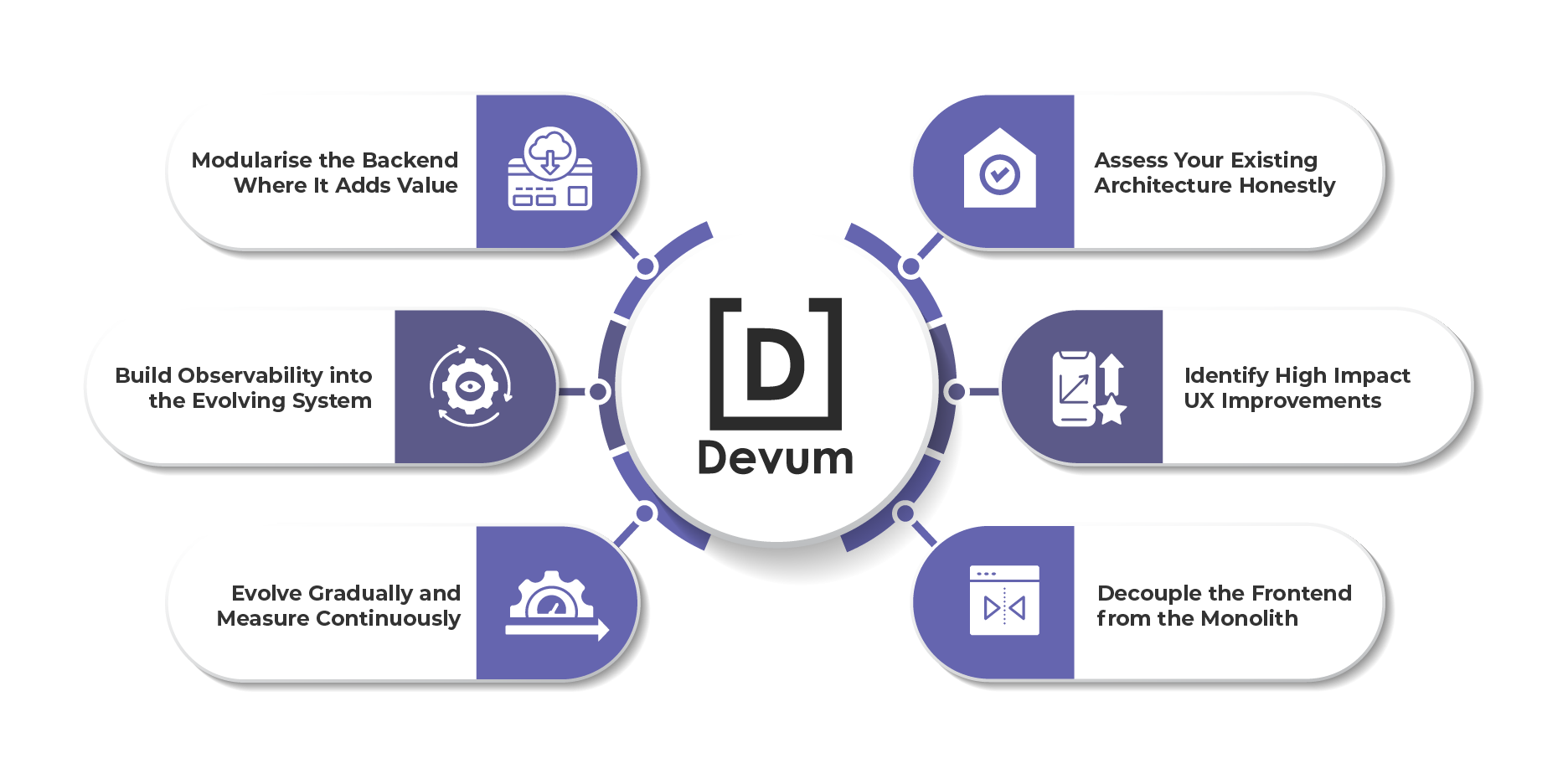
Step 1: Assess Your Existing Architecture Honestly
The first step is not selecting tools or defining a target architecture. It is understanding what you already have. This assessment should focus on identifying where tight coupling exists and how it affects both users and teams.
Key areas to evaluate include critical components and their interdependencies, shared database structures, performance bottlenecks during peak load, deployment and testing workflows, and team ownership boundaries. This exercise often reveals that a small number of user journeys are responsible for a disproportionate amount of friction and operational risk.
Step 2: Identify High Impact UX Improvements
Not all problems are equal. Some architectural changes deliver immediate, visible improvements to users, while others offer long-term benefits but little short-term relief.
For most organisations, frontend-backend decoupling delivers the fastest return. It directly addresses downtime, slow UX iteration, poor mobile experiences, and the inability to modernise incrementally. By focusing first on the user journeys that generate the most friction or business impact, teams can demonstrate value early and build momentum for further change.
Step 3: Decouple the Frontend from the Monolith
Decoupling does not mean rewriting everything. It means defining clear API contracts between frontend and backend systems and allowing the user interface to evolve independently.
Using a platform like Devum™, teams can build a new frontend layer using visual modeling while keeping the existing monolithic backend intact. User-facing features are migrated gradually, reducing risk and avoiding disruption. This approach enables continuous improvement while preserving system stability.
Step 4: Modularise the Backend Where It Adds Value
Backend modularisation is optional, not mandatory. Many organisations achieve sufficient scalability and UX improvement through frontend decoupling alone.
Where backend changes are needed, the focus should be on identifying clear business domains such as payments, claims, or inventory management. These domains can be isolated with defined boundaries, dedicated data stores, and asynchronous communication where appropriate. This step should be driven by concrete scaling or reliability needs, not architectural purity.
Step 5: Build Observability into the Evolving System
As systems become more modular, visibility becomes critical. Monitoring should move beyond system-wide metrics to track individual services, user journeys, and error patterns.
Tracking response times, error rates, and resource usage at a feature level allows teams to detect issues early and respond before users are affected. Observability is not an afterthought; it is what enables confident, continuous change.
Step 6: Evolve Gradually and Measure Continuously
Modernisation is not a project with a fixed end date. After each iteration, teams should measure improvements in performance, deployment frequency, UX metrics, and user satisfaction.
Feedback from users and internal teams should inform the next phase of evolution. This iterative approach replaces high-risk transformation programs with steady, compounding progress.
Why Devum™ Fits the Reality of Large-scale Systems
Devum™ is not positioned as a replacement for existing systems, but as an enabler of practical evolution. It addresses the exact constraints that make monolithic applications difficult to scale while avoiding the operational complexity of full microservices migrations.
1. Built for Frontend-Backend Decoupling
Devum™ separates user interface logic from backend services through well-defined APIs. This allows frontend teams to modernise interfaces, improve workflows, and enhance mobile experiences without destabilising core systems. It directly eliminates downtime caused by UI changes and enables incremental modernisation.
2. Visual Modelling That Reduces Risk
Workflows, validations, and user journeys are modelled visually rather than buried in code. This makes dependencies explicit and reduces the likelihood of unintended side effects. Visual models are easier to review, test, and evolve, lowering the risk of change in complex systems.
3. Independent Module Deployment
Devum™ enables individual screens or modules to be deployed without full system redeployment. This capability turns continuous deployment into a practical reality and removes the need for scheduled maintenance windows that frustrate users.
4. Consistency through Reusable Components
Reusable UI components and templates enforce consistency across applications. Instead of relying on manual design governance, Devum™ ensures that all screens inherit the same interaction patterns and visual language by default.
5. Role-based Experiences Without Complexity
Devum™ allows role-based visibility and access rules to be defined at the UI layer. Users see only what is relevant to them, reducing cognitive load and errors without requiring backend coordination.
6. Adaptive, Condition-based Workflows
Rigid, linear journeys are replaced with adaptive workflows that respond to user context, role, and data. This reduces abandonment, improves completion rates, and lowers support costs.
7. Responsive by Default
Devum™’s frontend layer is responsive across desktop, tablet, and mobile devices. The same backend supports multiple form factors without modification, enabling consistent experiences across channels.
What Organisations Typically Achieve with Devum™
Organisations adopting Devum™ often follow a predictable pattern. Initial months are spent assessing architecture and defining API boundaries. High-impact user journeys are modernised first, followed by gradual expansion to additional workflows.
Within six months, many report significant reductions in deployment time, faster UX iteration cycles, fewer production incidents, and measurable improvements in user satisfaction. Most importantly, teams regain confidence in making changes without fear of destabilising the system.
Conclusion: From Monolithic Pain to Sustainable Scale
Monolithic applications do not fail because they are poorly built. They struggle because they are asked to operate far beyond the conditions they were designed for. As user bases grow and expectations rise, architectural coupling manifests as UX friction, downtime, slow innovation, and operational risk.
These problems are not permanent. They are signals.
The most effective path forward does not involve tearing everything down and starting over. It involves decoupling what needs to change from what must remain stable. Frontend-backend separation, visual modeling, reusable components, and independent deployment enable organisations to modernise continuously without disrupting core systems.
Devum™ provides the foundation for this approach. It allows teams to evolve architecture at the pace the business demands, without betting everything on a single transformation initiative.
The question is no longer whether monolithic systems should evolve. It is how deliberately and how soon that evolution begins.
Every delay compounds technical debt and user frustration. Every incremental improvement builds momentum, confidence, and competitive advantage.
The tools exist. The patterns are proven. The next step is simply to begin.
Start your journey with Devum™ today. Sign up and build your first application.
👉 Subscribe to Devum™: https://Try.Devum.com/#/security/SignUp